
Hemoclipping in Patna
Have you been vomiting blood, passing black stools, or told that there is bleeding inside your stomach or intestine? These symptoms may indicate gastrointestinal bleeding and should never be ignored. In many cases, endoscopic hemoclipping can help control the bleeding without the need for surgery.
Early treatment is important because gastrointestinal bleeding can sometimes become serious if left untreated. Finding the exact source of bleeding allows your doctor to stop the bleeding safely and treat the underlying cause.
If you are looking for endoscopic hemoclipping in Patna, this page explains when the procedure is recommended, how it is performed, recovery, endoscoping hemoclipping cost in Patna, and when to consult Dr. Jitendra Mohan Jha.
Our clinic address: RN Tower, Bailey Rd, opposite Gola Road, near Atlantis Hospital, Rupaspur, IAS Colony, Danapur, Patna [Google Map Directions]
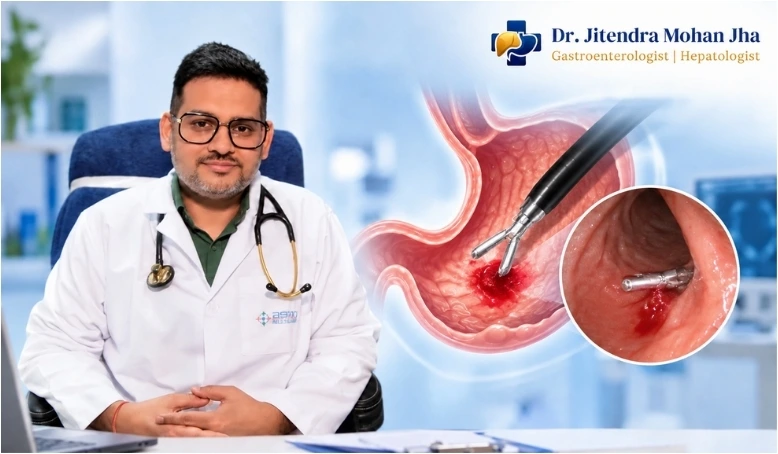
Hemoclipping by Dr. Jitendra Mohan Jha
At Dr. Jitendra Mohan Jha Gastro & Liver Clinic, patients receive expert diagnosis and treatment for gastrointestinal bleeding using advanced procedures such as endoscopic hemoclipping. Every patient is carefully evaluated before any treatment is recommended.
Dr. Jitendra Mohan Jha reviews your symptoms, medical history, blood reports, endoscopy findings, and current medicines to identify the exact cause of bleeding. If you are looking for the experienced gastroenterologist in Patna for gastrointestinal bleeding, the focus is on providing the right treatment while reducing the risk of future bleeding.
4,000+ Endoscopy, Colonoscopy u0026amp; ERCP Procedures Performed
DrNB (Medical Gastroenterology), MBBS (Honours), DNB (Internal Medicine)
MRCP (UK) International Training
8+ Years of Experience in Gastro u0026amp; Liver Care u0026amp; 8000+ Patients Treated
Patient Testimonials & Reviews
EXCELLENT Based on 79 reviews
 Posted on Google

 Naveen MishraVery good doctorPosted on Google
 AJAY KUMAR YADAVVery good doctorPosted on Google
 Sandeep KumarSir se Mai 2 machine se dikhba rha tha mera stomach problem tha fatty liver jo thik ho gya he is the best gastroenterology doctor in patna I love to recommend him he is the bestPosted on Google
 Abhishek BhushanI had chronical liver dieses and i am in continous consult with Dr Jitendra Mohan Jha. Things has improved alot and got releif . Thanks to Dr Jha and his team.Posted on Google
 Ravi PaswanDr sahab ka video fecbook par dekhe the wahn se sir ke bare me pata chale Or sir senmikr bahot achha laga sir bahot achha medicine diye bahot sudhar hua haiPosted on Google
 gautam kumarBest gastrology doctorPosted on Google
 Nippu KumarVery good Dr.Posted on Google
 Dipu KumarVery good Dr.
What is Hemoclipping?
Hemoclipping is an advanced endoscopic procedure used to stop bleeding inside the digestive tract without open surgery.
During an endoscopy, a small metallic clip is placed directly over the bleeding blood vessel or tissue. The clip helps seal the bleeding site immediately, allowing the area to heal naturally.
Because the clips are delivered through the endoscope, there are no external cuts or stitches, and recovery is usually quicker than traditional surgery.
Related Service: Endoscopy Clinic in Patna
When is Endoccopic Hemoclipping Recommended?
Your doctor may recommend endoscopic hemoclipping if active bleeding is found during an endoscopy.
Common situations include:
- Bleeding stomach ulcers
- Bleeding duodenal ulcers
- Bleeding after polyp removal
- Mallory-Weiss tears
- Dieulafoy’s lesion
- Bleeding blood vessels in the digestive tract
- Selected cases of upper or lower gastrointestinal bleeding
Not every patient with gastrointestinal bleeding needs hemoclipping. The procedure is recommended only when it is the most suitable option based on the source and severity of the bleeding.
What Conditions Can Hemoclipping Treat?
Hemoclipping is commonly used to control bleeding from several digestive conditions.
It may be recommended for:
- Bleeding peptic ulcers
- Upper gastrointestinal bleeding
- Bleeding after endoscopic polyp removal
- Certain vascular lesions
- Mallory-Weiss tears
- Selected lower gastrointestinal bleeding
In many cases, controlling the bleeding during the same endoscopy helps avoid additional procedures and supports faster recovery.
What is UGI Hemoclipping?
UGI hemoclipping is performed during an Upper Gastrointestinal (UGI) Endoscopy when bleeding is found in the oesophagus, stomach, or duodenum.
If active bleeding is identified during the examination, the doctor can often treat it immediately by placing one or more hemoclips through the endoscope.
This helps control the bleeding quickly, reduces further blood loss, and may help avoid the need for emergency surgery.
What Does EGD with Hemoclipping Mean?
EGD stands for Esophagogastroduodenoscopy, which is another name for an Upper GI Endoscopy.
If active bleeding is found during the examination, the doctor can place small endoscopic clips on the bleeding area during the same procedure.
This is known as EGD with hemoclipping, allowing both diagnosis and treatment to be completed in a single sitting.
How is the Hemoclipping Procedure Performed?
The hemoclipping procedure is usually performed during an upper GI endoscopy while you are kept comfortable with sedation.
During the procedure, your doctor will:
- Locate the source of bleeding
- Place one or more hemoclips over the bleeding site
- Confirm that the bleeding has stopped
- Monitor your condition before discharge
Most procedures are completed within 20 to 40 minutes, depending on the cause and severity of the bleeding.
How Should You Prepare?
Preparation depends on whether the procedure is planned or performed as an emergency.
Before the procedure, you should:
- Bring previous endoscopy reports
- Carry blood test results
- Inform your doctor about blood-thinning medicines
- Share details of allergies or ongoing medical conditions
- Bring your current medicine list
Following these instructions helps your doctor perform the procedure safely and effectively.
What Happens After Endoscopic Hemoclipping?
Most patients recover quickly after endoscopic hemoclipping. If the bleeding has stopped and your condition is stable, you may be able to return home the same day.
Recovery mainly depends on the condition that caused the bleeding rather than the clip itself. Your doctor will explain your medicines, diet, and follow-up plan before discharge.
After the procedure, you may be advised to:
- Take prescribed medicines regularly
- Eat a soft or light diet for a short period, if advised
- Avoid painkillers such as ibuprofen or diclofenac unless recommended by your doctor
- Attend follow-up appointments
- Contact your doctor if bleeding symptoms return
Seek immediate medical attention if you experience:
- Vomiting blood
- Black or tarry stools
- Severe abdominal pain
- Dizziness or fainting
- Persistent weakness
Is Hemoclipping Painful?
No. Hemoclipping is usually performed under sedation, so most patients remain comfortable throughout the procedure.
After the treatment, some people may notice mild throat discomfort following an upper GI endoscopy or temporary bloating. These symptoms usually improve within a short time.
Are Hemoclips Permanent?
No. Hemoclips are designed to stay in place only until the treated area heals.
The clips usually detach naturally as the treated area heals, so they rarely need to be removed.
Is Hemoclipping Safe?
Yes. Endoscopic hemoclipping is a well-established and commonly performed procedure for controlling gastrointestinal bleeding.
Like any medical procedure, it carries a small risk of complications, but serious problems are uncommon when performed by an experienced gastroenterologist. Your doctor will explain the expected benefits and possible risks before the procedure.
Related Service: ERCP Test Centre in Patna
Hemoclipping Cost in Patna
Many patients ask about the hemoclipping cost in Patna before planning treatment.
The total cost depends on the cause of bleeding, the complexity of the procedure, the number of clips required, hospital charges, and whether the treatment is performed as an emergency.
A general estimate includes:
- Consultation: ₹800–₹1,500
- Upper GI Endoscopy: ₹2,500–₹8,000
- Hemoclipping Procedure: Approximately ₹8,000–₹25,000+ (depending on the condition)
The exact cost is discussed after your evaluation and endoscopy findings.
What Affects the Cost of Hemoclipping?
The final cost may vary depending on several factors, including:
- The underlying cause of bleeding
- Number of clips required
- Emergency or planned procedure
- Hospital admission, if needed
- Additional investigations or treatment
Your doctor will explain the expected treatment plan and estimated cost after assessing your condition.
Anorectal Manometry in Patna
If you are looking for the anorectal manometry in Patna, choosing the right gastroenterologist and diagnostic facility is just as important as the test itself. Anorectal manometry is a specialised investigation that evaluates the function of the rectal and anal muscles, helping diagnose conditions such as chronic constipation, difficulty passing stool, fecal incontinence, and pelvic floor dysfunction.
At Dr. Jitendra Mohan Jha Gastro & Liver Clinic, the test is recommended only after a detailed clinical evaluation. Dr. Jitendra Mohan Jha carefully reviews your symptoms, medical history, previous investigations, and bowel habits to determine whether anorectal manometry is the most appropriate next step. The goal is to provide an accurate diagnosis and recommend the right treatment based on your individual condition, rather than performing unnecessary tests.
Can Hemoclipping Stop Stomach Ulcer Bleeding?
Yes. Endoscopic hemoclipping is one of the commonly used methods to control bleeding caused by stomach or duodenal ulcers.
If active bleeding is found during the endoscopy, clips can often be applied immediately to stop the bleeding. Whether this treatment is suitable depends on the location and severity of the ulcer.
Can Hemoclipping Stop Stomach Ulcer Bleeding?
Yes, but your doctor will advise you when it is safe to start eating.
Some patients can begin with liquids and gradually return to their normal diet, while others may be advised to follow a soft diet for a short period. Following your doctor’s instructions can help the treated area heal safely and reduce the risk of further bleeding.
Can Hemoclipping Stop Stomach Ulcer Bleeding?
Not every patient needs another endoscopy.
Follow-up depends on the cause of bleeding, your symptoms, and how well you recover. If required, your doctor may recommend a repeat endoscopy to check healing or monitor your condition.
What Happens If Hemoclipping Is Not Suitable?
Hemoclipping is not the right treatment for every type of gastrointestinal bleeding.
Depending on the cause and severity, your doctor may recommend other endoscopic treatments, medicines, angiographic procedures, or surgery if necessary. The decision is always based on your individual condition and the findings during evaluation.
Why Choose Dr. Jitendra Mohan Jha for Anorectal Manometry?
Gastrointestinal bleeding should never be treated by simply stopping the bleeding alone. Finding the exact cause is equally important to reduce the risk of future bleeding and plan the right treatment.
Dr. Jitendra Mohan Jha is a Consultant Gastroenterologist & Hepatologist with MBBS (Honours), DNB (Internal Medicine), DrNB (Medical Gastroenterology), MRCP (London), and advanced training from AIG Hospital, Secunderabad.
With 8+ years of experience, 8,000+ patients treated, and 4,000+ Endoscopy, Colonoscopy & ERCP procedures performed, he provides evidence-based care for gastrointestinal bleeding and other digestive disorders.
Patients choose Dr. Jitendra Mohan Jha Gastro & Liver Clinic for:
- Comprehensive evaluation before recommending treatment
- Advanced endoscopic hemoclipping for gastrointestinal bleeding
- Personalised treatment plans based on your condition
- Clear explanation of the procedure, recovery, and follow-up
- Complete digestive and liver care under one specialist
- Convenient location for patients from Patna and across Bihar
- The focus is to identify the source of bleeding, control it safely, and recommend the most appropriate treatment to help prevent future bleeding episodes.
The focus is to identify the exact cause of your bowel symptoms and recommend the most appropriate treatment based on your individual condition.
Related Service: Colonoscopy Test and Price in Patna
Book a Hemoclipping Consultation in Patna
If you have vomited blood, black stools, a bleeding ulcer, or have been advised to undergo therapeutic endoscopy, do not delay specialist evaluation. Bring your previous endoscopy, blood test, CT/MRI reports, discharge papers, and current medicine list for proper assessment.
You can consult Dr. Jitendra Mohan Jha for hemoclipping in Patna and gastrointestinal bleeding evaluation. He will review your symptoms, reports, medical history, medicines, and overall health before deciding whether endoscopic hemoclipping is appropriate. Dr. Jitendra Mohan Jha – Gastroenterologist & Hepatologist
Frequently Asked Questions
If you are looking for an experienced gastroenterologist for hemoclipping in Patna, Dr. Jitendra Mohan Jha provides evaluation and treatment for gastrointestinal bleeding using advanced therapeutic endoscopy. Treatment is recommended only after identifying the exact cause and confirming that hemoclipping is the most suitable option.
Endoscopic hemoclipping is a minimally invasive procedure used to stop bleeding inside the digestive tract. During an endoscopy, a small metallic clip is placed on the bleeding blood vessel or tissue to control the bleeding without open surgery.
Hemoclipping may be recommended for bleeding stomach ulcers, bleeding after polyp removal, Mallory-Weiss tears, Dieulafoy’s lesions, and certain cases of upper or lower gastrointestinal bleeding. The decision depends on the location and severity of the bleeding found during endoscopy.
The procedure is usually performed under sedation, so most patients remain comfortable. After the procedure, some people may experience mild throat discomfort or temporary bloating, which usually improves within a short time.
The procedure generally takes 20 to 40 minutes, depending on the source and severity of the bleeding. Most patients can return home the same day if their condition is stable.
The hemoclipping cost in Patna varies depending on the cause of bleeding, the number of clips required, hospital charges, and whether the procedure is performed as an emergency. Your doctor will explain the expected cost after evaluating your condition.
In many situations, endoscopic hemoclipping can control gastrointestinal bleeding without open surgery. However, the most appropriate treatment depends on the cause, severity, and location of the bleeding. The most appropriate treatment will be selected after carefully assessing your condition and the cause of the bleeding.
Yes. Hemoclipping is a well-established and commonly performed endoscopic procedure. While every medical procedure has some risk, serious complications are uncommon when it is performed by an experienced gastroenterologist.
Follow your doctor’s advice regarding medicines, diet, and follow-up appointments. If you notice vomiting of blood, black stools, severe abdominal pain, dizziness, or fainting after the procedure, seek medical attention immediately.