
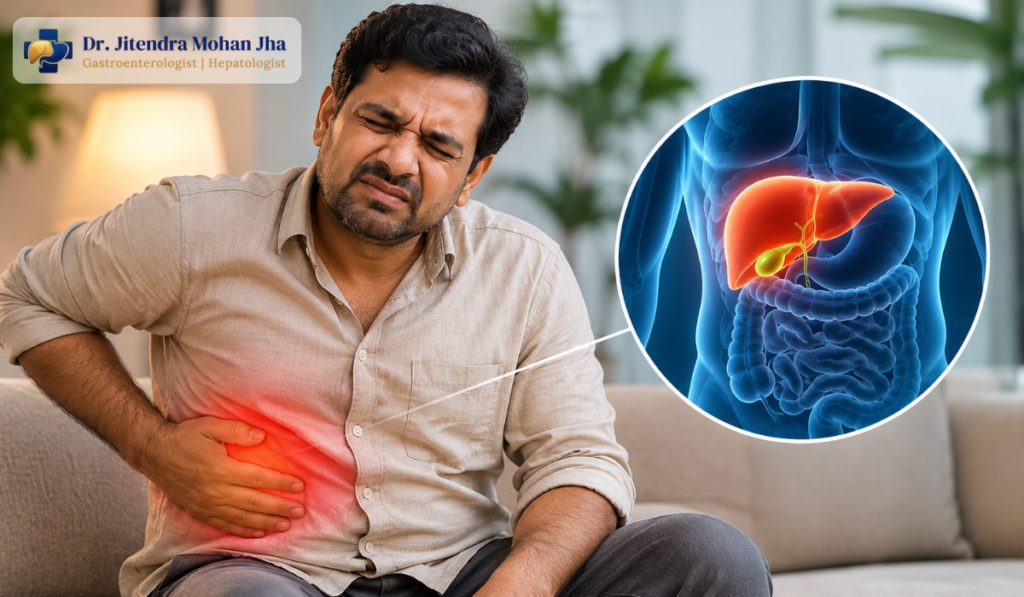
Right-side stomach pain can come from something as simple as bloating or indigestion, but it can also be related to the gallbladder, appendix, liver, kidney, or intestine. The location of the pain provides a useful clue, but it does not tell you the cause on its own.
What matters is the complete pattern: where the pain starts, how severe it is, how long it lasts, whether it follows meals, whether it is getting worse, and what other symptoms appear with it.
If you have pain in the right side of your abdomen, these details can help determine whether you can monitor the symptom or should seek medical evaluation.
Also Read: Indigestion Every Day: Common Causes and When to Consult a Doctor
Where Is the Pain Located?
The right side of the abdomen is not one single area. Doctors usually consider whether the discomfort is higher up beneath the ribs or lower down.
Right upper abdominal pain
Pain beneath the right ribs is commonly described as right upper abdominal pain. The gallbladder and liver are located in this region, although problems involving the stomach, intestine, pancreas, or right kidney can also cause discomfort here.
Right lower abdominal pain
Pain closer to the lower-right abdomen has a different range of possible causes. Appendicitis is one of the important conditions doctors consider, especially when the discomfort becomes progressively worse.
Urinary or intestinal problems can also produce pain in this area.
This is why simply pointing to the right side and saying “it hurts here” is not enough to determine what is happening.
Read This: H. Pylori Testing: Which Test Is Best, Cost, Preparation, and Results Explained
What Can Cause Right-Side Stomach Pain?
Gallstones and gallbladder problems
The gallbladder is an important consideration when pain occurs beneath the right ribs.
If a gallstone temporarily blocks a bile duct, it can trigger a gallbladder attack. The pain is usually felt in the upper-right abdomen and may continue for several hours. Some people notice the problem after a heavy meal, and nausea or vomiting may occur.
An ultrasound finding of gallstones does not automatically prove that the stones caused the pain. Many people have “silent” gallstones that never produce symptoms.
Pain lasting several hours, particularly when accompanied by fever, chills, vomiting, jaundice, dark urine, or pale stools, needs prompt medical attention because these features can occur when a gallbladder or bile-duct problem becomes complicated.
Appendicitis
Appendicitis becomes an important possibility when pain moves toward or settles in the lower-right abdomen.
A typical pattern begins with discomfort around the belly button before the pain shifts downward and to the right. It may become more painful with movement, coughing, sneezing, or deep breathing. Loss of appetite, nausea, vomiting, fever, or abdominal swelling can occur as well.
Not everyone develops the classic pattern. If appendicitis is suspected, it is safer to get medical assessment promptly because untreated appendicitis can lead to complications such as a ruptured appendix or infection inside the abdomen.
You May Like: Liver Function Test High: What Abnormal LFT Results Really Mean
Liver-related conditions
The liver occupies a large part of the upper-right abdomen, so some liver conditions can cause discomfort in that region.
For example, inflammation of the liver may be accompanied by upper abdominal discomfort along with symptoms such as fatigue, nausea, dark urine, or yellowing of the eyes or skin.
However, right upper abdominal pain does not automatically mean that the liver is responsible. Other organs in the same area can produce similar symptoms. Blood tests and imaging may be needed when the clinical findings point toward a liver or biliary problem.
Kidney stones and urinary problems
A problem in the right kidney or ureter may feel like abdominal pain even though the urinary system is responsible.
A stone in the urinary tract may cause severe, wave-like discomfort that starts around the flank or back and can later spread downward toward the abdomen or groin. Blood in the urine, burning during urination, frequent urination, nausea, or vomiting may provide additional clues.
This is one reason a doctor may ask about urinary symptoms even when you initially describe your problem as stomach pain.
Gas, indigestion, and other digestive problems
Gas, bloating, constipation, indigestion, gastritis, peptic ulcers, intestinal infections, and inflammatory conditions can also cause abdominal discomfort.
The pattern is often more useful than the word “gas.” A mild, short-lived discomfort associated with bloating is different from pain that becomes severe, remains constant, or occurs with fever or vomiting.
So if right-sided abdominal pain keeps returning, it should not automatically be dismissed as trapped gas.
Also Read: Stomach Pain After Eating Food: Causes, Warning Signs, and Treatment
Can Right-Side Stomach Pain Happen After Eating?
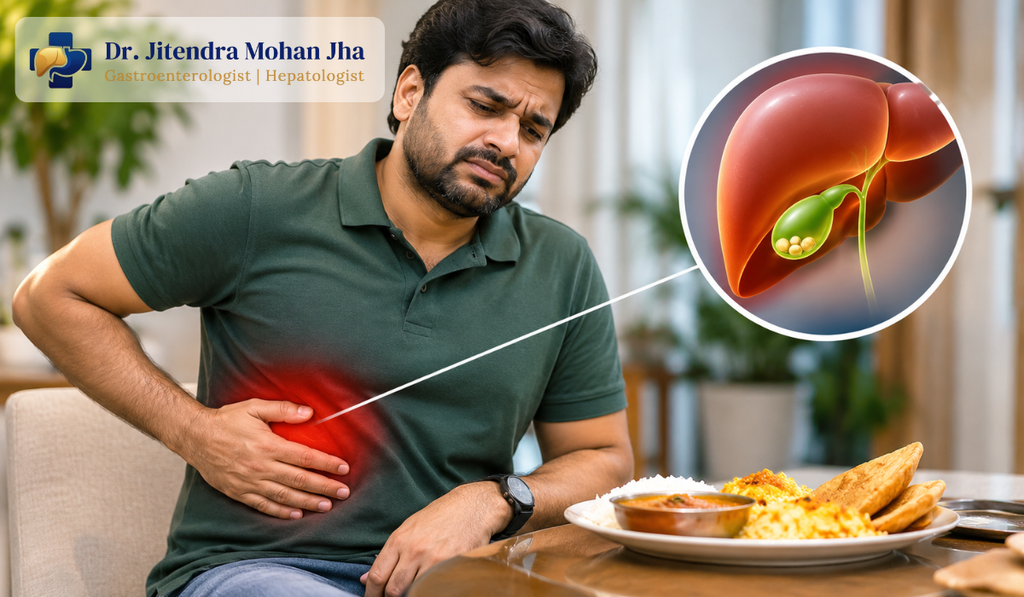
Yes. The timing of the pain in relation to meals can provide useful information.
Gallbladder attacks, for example, commonly occur after heavy meals. Other digestive problems can also become more noticeable around mealtimes.
Rather than assuming that a particular food is responsible, pay attention to the pattern:
- What did you eat before the discomfort began?
- How soon after eating did the pain appear?
- Does the same thing happen repeatedly?
- How long does the pain last?
- Do nausea, vomiting, bloating, heartburn, or loose stools occur at the same time?
These details can make a medical consultation more useful.
Is Right-Side Stomach Pain From Gas or Something More Serious?
It can be difficult to tell from the sensation alone.
Gas and bloating can cause discomfort on one side of the abdomen. However, persistent or worsening pain should not automatically be blamed on gas.
Pay closer attention if the pain:
- Keeps coming back
- Lasts longer than expected
- Is becoming more intense
- Interferes with eating or normal activities
- Occurs with fever or repeated vomiting
- Appears along with jaundice
- Is associated with blood in the stool or urine
The combination of symptoms is often more informative than the location of the pain by itself.
When Should You See a Doctor Immediately?
Some patterns should not be managed by waiting at home.
Seek urgent medical care if right-sided abdominal pain is accompanied by:
- Severe or rapidly worsening pain
- Persistent vomiting
- Fever or chills
- Yellowing of the eyes or skin
- Black or bloody stools
- Blood in the urine
- Fainting, severe dizziness, or marked weakness
- Significant abdominal swelling or severe tenderness
- Chest pain or difficulty breathing
For example, suspected appendicitis requires prompt assessment. Similarly, prolonged abdominal pain with fever, vomiting, or jaundice can indicate a complication involving the gallbladder or bile ducts and should be evaluated quickly.
If the pain is mild but repeatedly returns or remains unexplained, you may not need emergency care, but arranging a medical consultation is still sensible.
Read This: Why Do I Feel Bloated After Every Meal? 9 Possible Digestive Causes
How Long Should You Wait Before Seeing a Doctor?
There is no universal number of hours or days that applies to everyone.
If mild discomfort settles completely and does not return, immediate testing may not be necessary. But if the pain keeps recurring, does not settle, becomes more frequent, or starts interfering with normal activities, it is reasonable to arrange an evaluation.
Do not wait for a fixed period if the pain is severe, rapidly worsening, or accompanied by warning signs such as fever, repeated vomiting, jaundice, bleeding, fainting, or marked abdominal tenderness.
How Do Doctors Find the Cause of Right-Sided Abdominal Pain?
The investigation required depends on the suspected cause, so one diagnostic test cannot provide an answer for every patient.
The evaluation usually starts with questions about the pain and a physical examination. Your doctor may ask when it began, exactly where you feel it, whether it moves elsewhere, whether food affects it, and whether you have experienced fever, vomiting, bowel changes, urinary symptoms, or jaundice.
Depending on the suspected cause, investigations may include:
- Blood tests
- Liver and bile-related tests
- Urine examination
- Abdominal ultrasound
- CT scan
- Other imaging or digestive investigations when appropriate
For suspected gallstones, doctors use the symptoms, examination, blood tests, and imaging together. Ultrasound is the preferred imaging test for finding gallstones.
For suspected appendicitis, evaluation may include blood and urine testing and imaging such as ultrasound, CT, or MRI depending on the patient’s circumstances.
The important point is that not everyone with right-sided abdominal pain needs every available test. The investigation should follow the clinical findings.
Do You Always Need an Ultrasound?
No.
Ultrasound is particularly useful when a gallbladder or other right-upper-abdominal problem is suspected. It does not, however, provide the answer for every type of abdominal pain.
For acute right-upper-quadrant pain, ultrasound is generally the preferred initial imaging study. For some causes of lower-right abdominal pain, CT or another imaging method may be more appropriate depending on the patient’s situation.
Your doctor can decide which investigation is appropriate after considering your symptoms and examination.
When Should You Consult a Gastroenterologist in Patna?
A consultation is appropriate when right-sided abdominal pain keeps returning, remains unexplained, or occurs with other digestive symptoms.
You should consider an evaluation if the discomfort repeatedly follows meals, occurs with nausea or bloating, accompanies abnormal liver-test results, or continues despite reasonable changes in your eating habits.
A Gastroenterologist in Patna can assess whether the symptoms suggest a digestive, liver, gallbladder, or another abdominal problem and determine whether further testing is necessary.
At Dr. Jitendra Mohan Jha Liver & Gastro Clinic, the evaluation is based on the patient’s symptoms, medical history, examination findings, and clinically appropriate investigations rather than assuming that every case of right-sided pain has the same cause.
Read This: Endoscopy Test Price: When Is the Procedure Recommended and What Should You Know?
Frequently Asked Questions
Which conditions can lead to discomfort on the right side of the abdomen?
Possible causes include gallbladder disease, appendicitis, liver-related conditions, kidney stones, gas, indigestion, constipation, ulcers, and intestinal problems. The actual cause depends on the overall symptom pattern.
What causes right upper abdominal pain?
Discomfort beneath the right ribs can occur with gallbladder or liver conditions, but stomach, intestinal, pancreatic, and kidney problems can also affect this area.
Could gallstones be responsible when right-sided abdominal discomfort repeatedly develops after meals?
It can. A gallstone-related episode may produce pain beneath the right ribs, and some people notice these attacks following a substantial meal. However, pain after eating is not specific to gallstones and can occur with other digestive conditions as well.
Can gas cause pain on the right side?
Yes, gas and bloating can produce discomfort on one side of the abdomen. But persistent, severe, or progressively worsening pain should not automatically be attributed to gas.
How can I tell if right-side pain could be appendicitis?
Pain that moves toward the lower-right abdomen and becomes progressively worse, particularly when accompanied by nausea, vomiting, fever, or loss of appetite, can occur with appendicitis. Suspected appendicitis needs prompt medical assessment.
Do I need an ultrasound for right-sided abdominal pain?
Not always. Ultrasound is especially useful when gallbladder or right-upper-abdominal disease is suspected, while other conditions may require different investigations.
Final Takeaway
Right-sided stomach pain is a symptom rather than a diagnosis. The possible causes range from temporary digestive discomfort to gallbladder disease, appendicitis, kidney stones, or liver-related conditions.
The most useful clues are the exact location, onset, duration, severity, relationship with meals, and symptoms that occur alongside the pain.
Mild discomfort that settles and does not return may not require immediate investigation. Recurrent or unexplained pain deserves medical evaluation, while severe or rapidly worsening pain, fever, repeated vomiting, jaundice, bleeding, fainting, or marked tenderness requires prompt medical attention.
If you are unsure about the cause of recurring right-sided abdominal pain, an appropriate clinical evaluation can help determine what needs to be investigated and what does not.